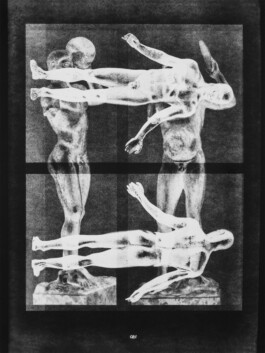
Dissolving Views — 2024
DE
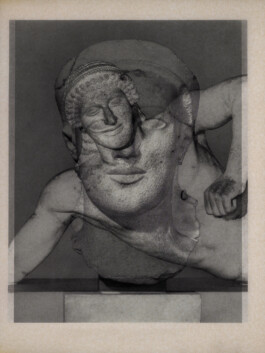
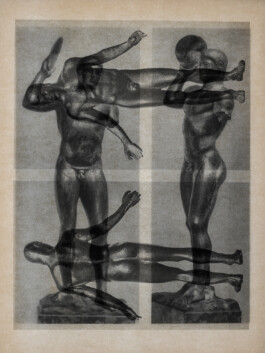
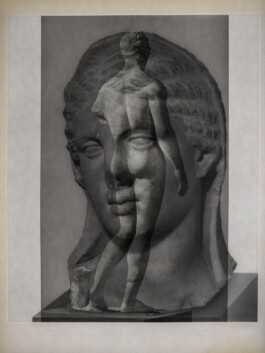
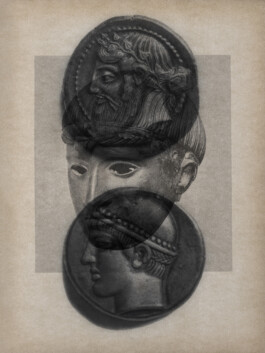
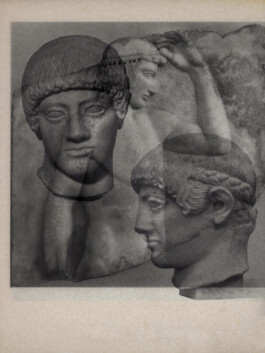
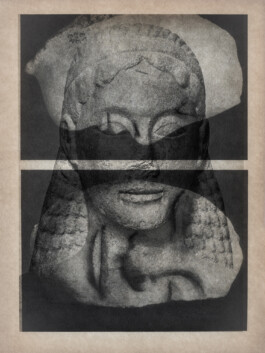
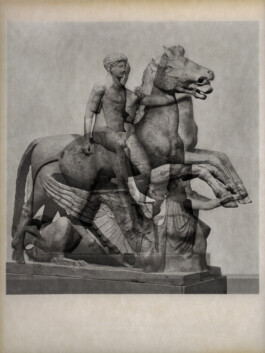
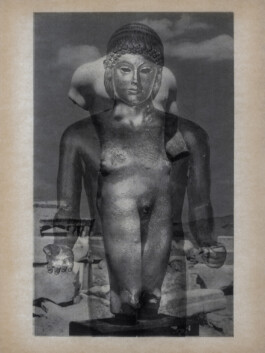
Das Ausgangsmaterial für meine künstlerische Auseinandersetzung finde ich in Anthologien zu Bildhauerei und Skulptur, Katalogen von Museen und Galerien, Fachliteratur zur Vorgeschichte und bildenden Kunst. Diesem Konvolut werden einzelne Buchseiten entnommenen, unter Zuhilfenahme einer Leuchtplatte durchleuchtet und anschließend fotografisch reproduziert. Selbstreferentiell bewegen sich die vermeintlichen Doppelbelichtungen in einem Spannungsfeld zwischen Abstraktion und Figürlichkeit, Materialität und der Auflösung von Formen sowie gestalterischen Zufällen die erzählerische Momente evozieren. Was sie gleichermaßen verbindet, ist eine immanente Referenz auf das Buch als Herkunftsort der Abbildungen und unsere mit dem Medium verknüpfte Rezeption bildhauerischer Werke. Die steinernen Körper und Skulpturen erfüllen hier vielmehr die Funktion einer Art Projektionsfläche und verweisen über sich hinaus.
Welche Bedeutung haben Bilder für uns und wie verhandeln wir die Distanz zwischen einem Objekt und seiner fotografischen Reproduktion be-
ziehungsweise zwischen einer fotografischen Reproduktion und unserer Erinnerung an das beziehungsweise Idee von dem, was darauf
abgebildet ist? Die Paradoxie, dass die Reproduktion dem Original einerseits gleich und andererseits entgegen gesetzt ist, stellt innerhalb der künstlerischen wie der kunstwissenschaftlichen Diskurse nach wie vor einen blinden Fleck dar. Die Reproduktion im allgemeinen
und somit alle Reproduktionen sind nicht so sehr minderwertiges und notwendig unvollkommenes Surrogat des unerreichbaren Originals, sondern dessen Derivat und Erweiterung. Die Geschichte eines jeden originalen Werkes ist im selben Maße die Geschichte seiner Reproduktionen.
ENG
My approach mirrors a specific notion of archaeology which states that „[…] archaeology operates as the reading of a book, only to rip the pages out as you go along.“ Following this guiding principle individual book pages are extracted from my personal archive consisting
of anthologies on sculpture, museum and gallery catalogs, as well as scholarly literature on prehistory and the visual arts. In the follow-
ing these isolated book pages are being illuminated using a lightbox and get photographically reproduced. These seemingly double-
exposed images operate self-referentially within a field between abstraction and figuration, material presence and the dissolution of form, as well as compositional coincidences that evoke narrative moments. What connects them is an inherent reference to the book as the
images’ origin and our perception of sculptural works through the medium of print. The depicted stone bodies and sculptures serve less as subjects in themselves and more as projection surfaces, pointing beyond their own materiality.
What role do images play for us, and how do we negotiate the distance between an object and its photographic reproduction — or between that reproduction and our memory or idea of what is depicted? The paradox that a reproduction is both identical to and at odds with the
original remains a blind spot in both artistic and art-historical discourse. Reproductions, in general should not be seen merely as a defi-
cient or necessarily incomplete surrogate of an unattainable original, but rather as its derivative and extension. The history of
any original work is, to the same extent, the history of its reproductions.

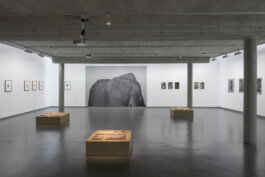
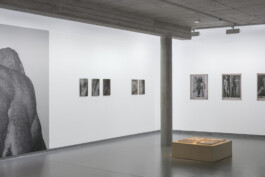
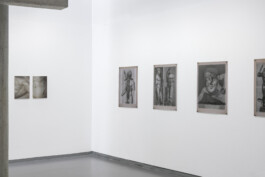
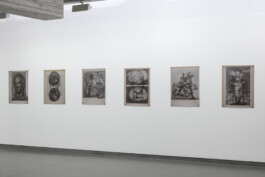
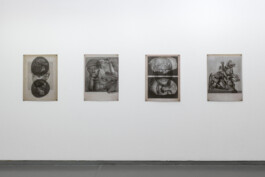
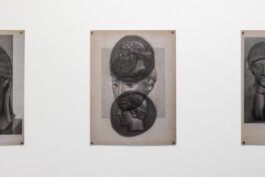
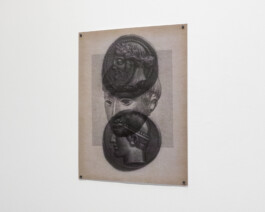
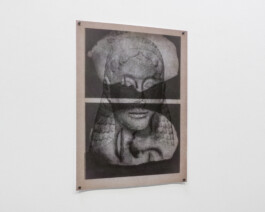
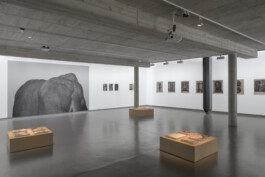
Dissolving Views — Forum der Städtischen Galerie Lüdenscheid, 2024
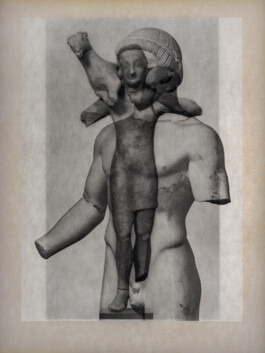
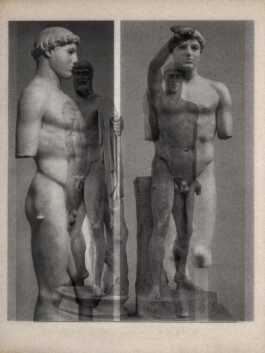
Dissolving Views Nr.11, 2024
Dissolving Views Nr.8, 2024
Dissolving Views Nr.6, 2024
Dissolving Views Nr.4, 2024
Dissolving Views Nr.3, 2024
Dissolving Views Nr.13, 2024
Dissolving Views Nr.2, 2024
Dissolving Views Nr.14, 2024
Dissolving Views Nr.12, 2024
Dissolving Views Nr.1, 2024